
The Encounter Between Engraving and Mosaic
Some encounters seem coincidental, but when observed more closely, they reveal a profound necessity. This is the case of Doppia Firma, an art project born from the convergence of different languages, techniques, and visions, with the aim of generating a new shared expressive form.
The project brings two artists and two practices into dialogue: engraving and mosaic. On one side, Ecuadorian artist Hernán Cueva Velásquez, an engraver and master graphic artist with a long international career, and on the other, Tiziana Mondini, founder and director of the In Tessere mosaic school in Narni.
As part of this project, Hernán Cueva Velásquez will be a guest artist in Narni from May 4 to 9, 2026. During this week of shared work and research, the operational core of Doppia Firma will emerge, a dialogue between the engraved mark and the mosaic language.
Two Languages, One Common Research
At first glance, engraving and mosaic seem to belong to opposite worlds. Engraving originates from a gesture that carves and incises material to leave a mark that will become an image through printing. It is an immediate and physical language that carries the energy of the gesture.
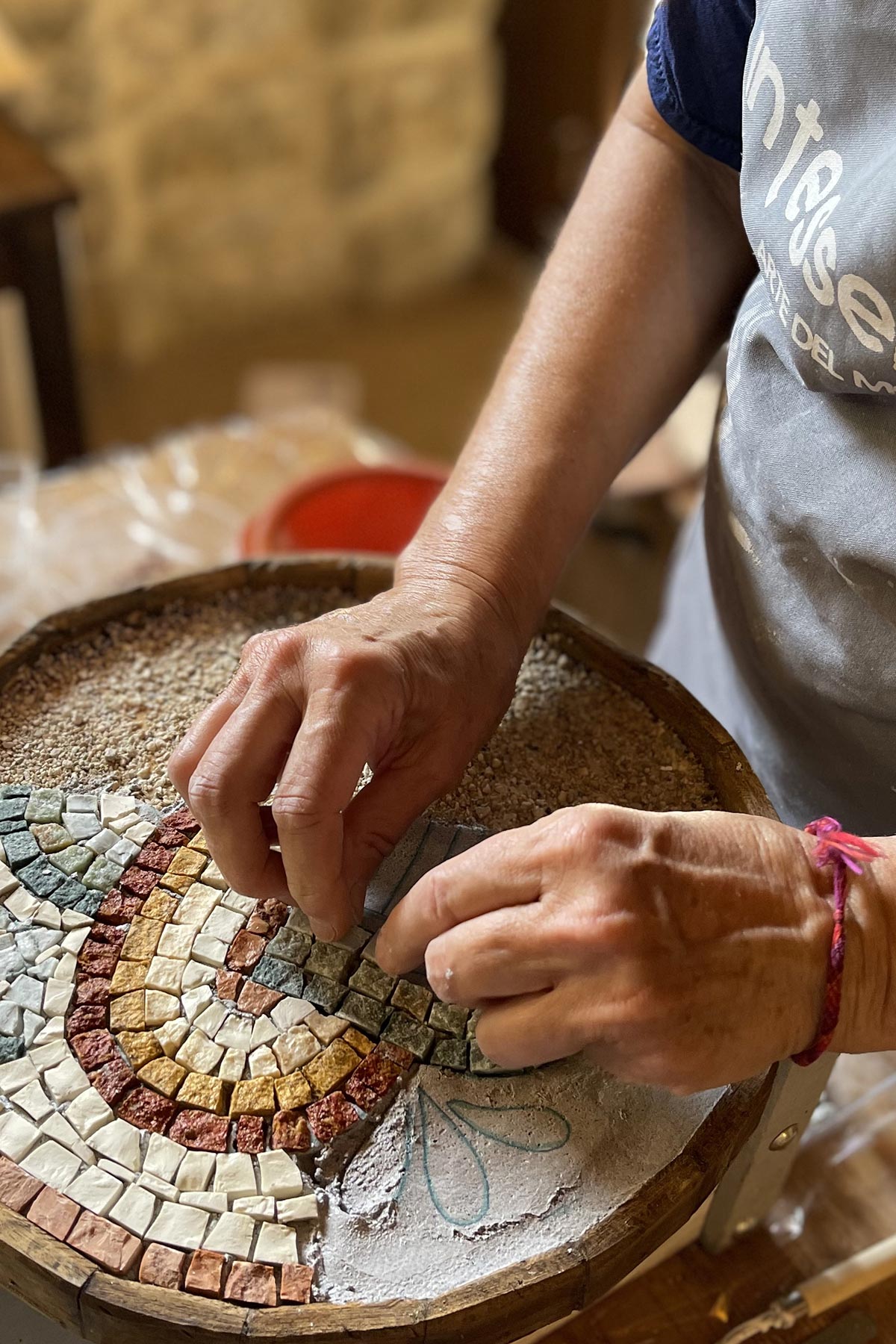
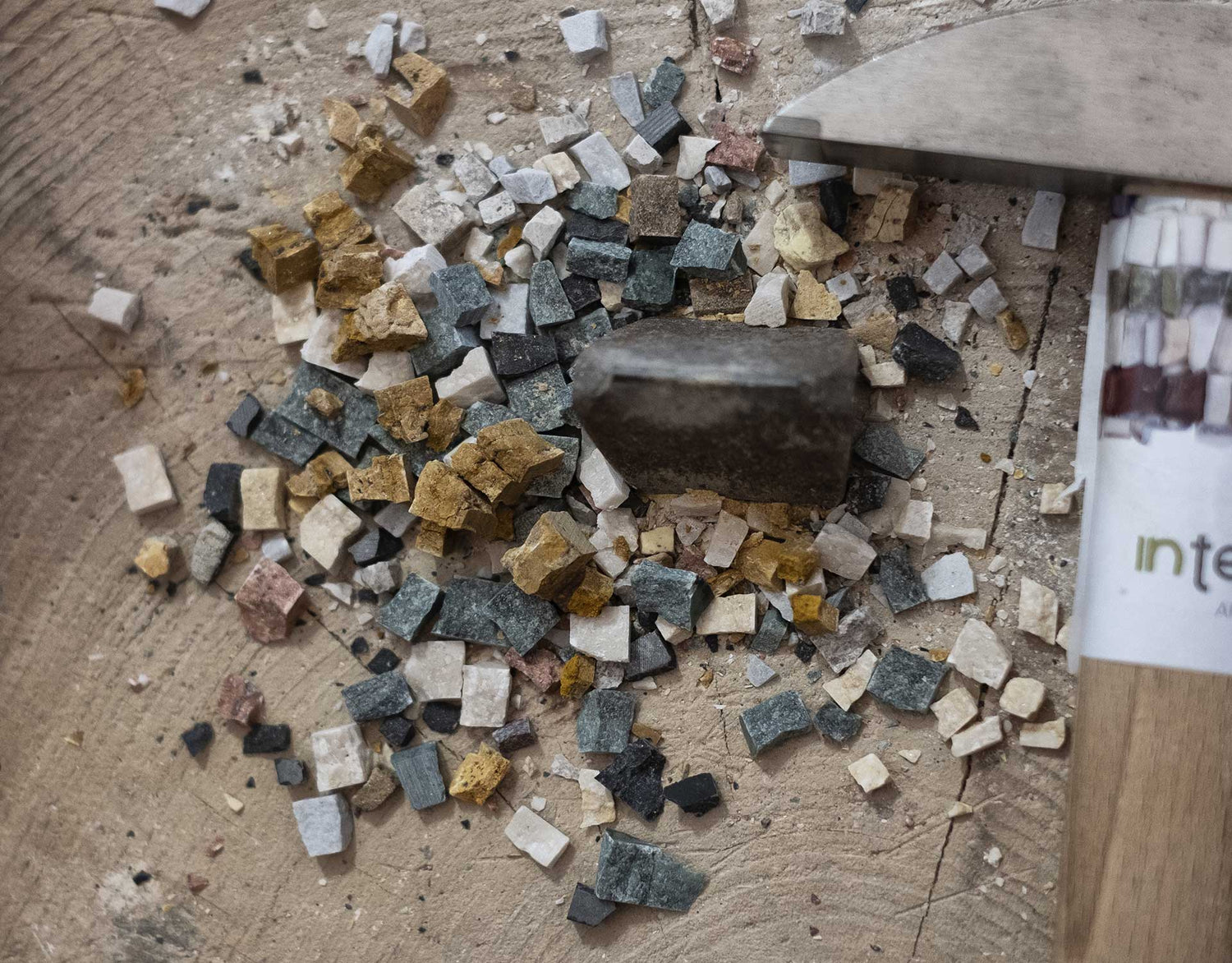
Mosaic, on the other hand, is built by addition: small fragments of stone, glass, or enamel, known as tesserae, are placed one after another to form a complex image.
Yet these two languages share a common root; both transform gesture into permanent memory, and both construct images through the repetition of minimal units, whether a mark or a tessera. The Doppia Firma project stems precisely from this hidden affinity.


Hernán Cueva Velásquez, The Mark as Energy
For over fifty years, Hernán Cueva Velásquez has explored the expressive possibilities of engraving. Educated at the Facultad de Artes of the Universidad Central del Ecuador, he continued his artistic training in Europe, particularly in Italy and France, where he specialized in intaglio techniques.
His artistic research is characterized by a dynamic and vibrant mark, with human and animal figures in motion, intense compositions, and vivid colors. His work engages with various artistic traditions, from European Expressionism to Latin American Muralism.
His works are held in international collections and institutions, including the Pinacoteca dell’Affari Steri in Rome, the Museo Latinoamericano in Dresden, and the museums of the Banco Central del Ecuador. Throughout his career, he has received important accolades, including the Silver Medal at the Varna International Biennial.

As art historian Mónica Vorbeck emphasizes, Hernán Cueva's work represents one of the most significant bodies of 20th-century printmaking in Ecuador. His research lies between the formal investigation of modernism and a respect for the essential nature of the engraving medium. Recurring thematic cores emerge in his creative journey: the popular festivals and traditions of the Andean world, myth and the couple in their symbolic and mystical dimension, landscape as an expression of inner sensibility, and finally, a critical gaze towards the contemporary, global, and media-driven world.


In Tessere, Mosaic as a Contemporary Language
Welcoming the artist to Narni will be Tiziana Mondini, founder of the In Tessere mosaic school. The school was founded with the idea of promoting mosaic as a contemporary artistic language, capable of interacting with other disciplines and reinterpreting a millennia-old tradition.
Within the In Tessere workshop, artistic research, training, and experimentation coexist. Here, mosaic is not just a technique, but a tool to translate images, signs, and visions into a new material made of light, color, and fragments. It is precisely this context that makes the encounter between graphic art and mosaic possible.

The Artist Residency, The Heart of the Project
From May 4 to 9, 2026, the In Tessere workshop will become an open research space. During the artist residency, Hernán Cueva will bring his graphic works, engravings, prints, and drawings, while Tiziana Mondini will share her knowledge of mosaic techniques and materials.
The work will not be a simple transposition or copy, but a true process of interpretation and transformation. How does a swift and incisive mark translate into a composition made of tesserae? How is the energy of color preserved when it moves from ink to stone or enamel? The answers will emerge during the residency itself.
The public will be able to witness the creative process by visiting the workshop throughout the week.
The Concluding Exhibition
The project will culminate with the final Doppia Firma exhibition, which will be inaugurated on May 14, 2026, at the Casa del Popolo di Narni. The works resulting from the collaboration between the two artists will be exhibited, along with Hernán Cueva Velásquez's engravings that originated the research.
The exhibition will be open to the public from May 14 to 18, 2026.
Doppia Firma is an experience of encounter, transformation, and collaboration, two artistic identities intertwined to create a shared work.